
Personal Development
A single eight-hour day, delivered in person in Calgary or live remote, at the same price either way.
Providing 0.8 CEU (Continuing Education Units) or 8 PDH (Professional Development Hours)
Course Overview
Most managers inherit a safety culture rather than build one. Managers taking new responsibilities in an organization are not likely to know the real safety culture. You arrive in a new role, the plant has been running a certain way for years, and nobody can tell you which of the on-going routine practices are truly acceptable and genuinely safe, and which have simply not yet failed.
This course is about that problem.
It covers the concepts a facility leader needs to hold an informed opinion on risk: what a loss incident actually is, how energy sources and loss of control combine, what leading indicators tell you that lagging indicators cannot, and where the risk management tools fit. It then moves to what you do with that understanding as a leader. Setting expectations. Training. Checking. Correcting. Reinforcing.
Running through all of it is the Risk Alive Risk Intelligence Companion (the “Companion”), a proprietary artificial intelligence tool built on anonymized industry Process Hazard Analysis (PHA) data. Participants use it during the course on their own facility scenarios, after the instructor demonstrates it on a case study.
The Method
The course teaches one repeatable sequence that leaders can run using the Companion on any unit, any hazard, any risk, any week of the year. For example, this four-step sequence demonstrates how to apply the Companion to any operation of interest:
Discover. What high-consequence scenarios have industry PHAs already identified on operations like ours?
Challenge. What could we be missing in terms of effective safeguards or hazards and risks, and which scenarios are commonly underestimated?
Prioritize. Of everything on the table, what are the critical few?
Act. What should leadership do next, and what do we check tomorrow?
The Companion is used as a challenge function, not as a substitute for the expertise already in the room. Leaders still decide and leaders remain accountable.
What You Will Be Able to Do
By the end of the course, participants can:
• Apply the PHA industry knowledge to a current operational concern, a foresight planning exercise, or a scenario they are unsure about
• Explain the fundamentals of risk management in terms their operators and their executives both understand
• Identify the sub-standard conditions and practices that indicate where a safety culture actually sits, as opposed to where the policy says it sits
• Use risk assessment tools as a coaching conversation rather than a paperwork exercise
• Apply leadership tools and key practices to evaluate workplace safety culture, recommend specific management system improvements and defend them
• Ask better questions and gain better insights before accepting the current level of risk on any unit
What Is Covered
Module 1: Foundations of Risk Management Leadership
Definitions everyone in the room agrees on. The leadership responsibility for operational risk. Understanding loss. The difference between an occupational incident and a process safety incident. The risk management cycle. Instruction on how to apply the Companion and a Companion exercise.
Module 2: Understanding How Incidents Develop
Hazard Recognition and the Energy Wheel. Assessing and controlling risks. Lagging and leading indicators. The incident model and the Discovery Approach. The incident investigation work process, categories of causes, an introduction to root cause analysis, and a new perspective of the Swiss Cheese model. A Companion exercise.
Module 3: Building an Effective Risk Management System
The elements of an integrated system, and the case studies revisited through that lens. The tools that support an effective risk management system: FLRA, SQRA, What-If analysis, bow-tie analysis, and Prevention Through Design. Process safety and catastrophic incident prevention, including the Incident Pyramid, the Accident Ratio Study, and “Mine the Diamond”: focusing finite resources on the critical few risks with severe potential consequences. Management of change. Auditing and continuous improvement. A Companion exercise.
Module 4: Leading Improvement and Learning from Others
A strategy of five practical actions to improve safety performance. Leadership at all levels. The Compressor Noise Case and the application of the Companion. A final Companion exercise, which completes the Operational Risk Intelligence Brief that each participant builds across all four exercises.
A Companion exercise runs at the end of each module, so participants practise the same four-step method four times rather than sitting through one technology segment at the end.
What You Take Home
Every participant can generate a combined multi-page Operational Risk Intelligence Brief written on an operation of their choosing and centered on any of the key leadership concepts of interest as presented in the course. For example, a brief built around “Mine the Diamond” covers:
• High-consequence scenarios that industry PHAs suggest should be checked
• Leading indicators to watch for, as signs of degradation before a consequence appears
• Potential blind spots, meaning what may have been overlooked or normalized
• Leadership questions to ask and verify
• Critical safeguards whose health matters most
• One first action to take on returning to site
Bring anonymized or non-confidential information about a facility, a unit, a recent event or a recurring weak signal. The exercise is built on your own operation, so arriving with a prepared description of the technology will be extremely advantageous to your time in the course.
The Case Studies
Three real-world cases are used to teach the concepts and to show the Companion in action.
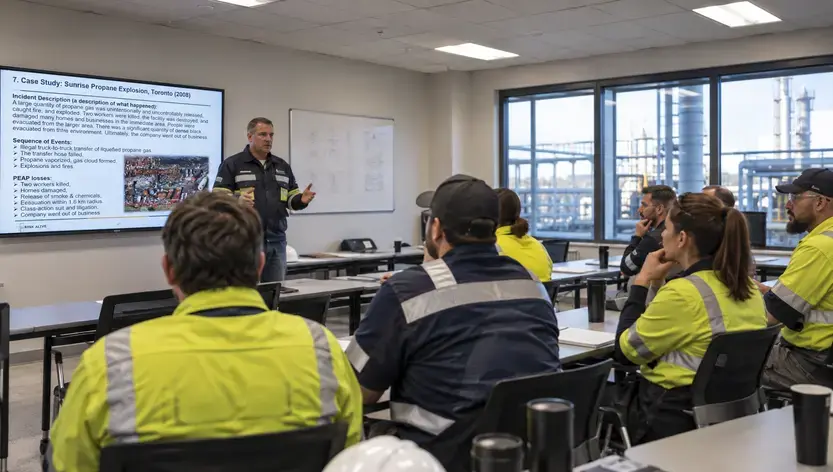
Sunrise Propane Explosion, Toronto. At around 3:50 in the morning on August 10, 2008, a propane release ignited at an industrial gas facility next to a residential part of Toronto. Two workers were killed. Residents within 1.6 kilometres were evacuated in the dark. The company did not survive it. Participants work backwards from the incident outcome to the management system weaknesses that allowed it.
The compressor noise. A 10,000 HP reciprocating compressor in ethylene service, discharge pressure above 40,000 psig, and a knocking noise that matched the compressor’s rpm exactly. The question put to the room is the one that was put to the operating team at the time of the event: Do we keep the plant running (production pressures) or do we shut it down? The session then shows what the Companion returns when that same question is asked today.
Fernie Memorial Arena. On October 17, 2017, an ammonia and brine refrigeration failure at a municipal rec centre in Fernie, BC, released ammonia into an enclosed room. Three people died and 95 residents were evacuated from 55 nearby homes. Technical Safety BC’s investigation report made 18 recommendations to improve ice rink refrigeration safety. The case sharpens the distinction between an occupational loss incident and a process safety loss incident.
The Risk Intelligence Companion
The AI is the interface. The industry intelligence behind it is what participants learn to apply to their own facilities.
Risk Alive has structured causes, consequences, safeguards and risk rankings from real, anonymized industry PHA studies. The Companion is how a participant asks that body of experience a question in plain language. In the course, participants bring a process safety event or a technology from their own facility and ask what industry PHAs have already identified. What causes and consequences show up against this hazard. Which safeguards are commonly credited, and which controls industry PHAs rely on most. What their own assessment might have missed.
It does not replace the experience your people already have. It lets them test that experience against what has already been assessed and protected against across industry. For a leader who has just moved into an unfamiliar unit, that is the difference between an opinion and a position.
Every participant gets free access to the Companion during the course and keeps it afterward.
Your Instructor
John R. Cocchio, BASc (Chem. Eng.), MBA
John spent 32 years (1980-2012) at Dow Chemical Canada as a process engineer, production supervisor, reliability and improvement leader, and EH&S delivery leader. The units were world-scale: chlor-alkali, EDC-VCM, polyethylene, chlorinated solvents, epoxy resins, light hydrocarbons and wells storage, across Sarnia, Fort Saskatchewan, and Prentiss.
He then taught Leadership in Risk Management to senior engineering students at the University of Alberta, the David and Joan Lynch School of Engineering Safety and Risk Management, alongside introductory process safety management, from 2012 to 2025. He has delivered seminars and workshops through APEGA and directly to client companies.
John was a professional engineer, a member in good standing at the time of his retirement, with Professional Engineers Ontario (1980-1998) and the Association of Professional Engineers and Geoscientists of Alberta (1998-2025).
Who Should Attend
Written for people who carry responsibility for a facility at any level rather than for people who write the procedures.
• Operations: operators, operating and power engineers, process and plant engineers, production supervisors, operations leaders, plant managers
• Maintenance: maintenance supervisors, maintenance engineers and maintenance leaders
• Process safety, reliability, EHS and risk professionals, including safety specialists and safety managers
• New graduates, engineers in training (EITs) and high-potential engineers
• Professionals new in role, under five years of experience, including new-in-role supervisors
• Intermediate and senior professionals and technical leaders, five to fifteen years
Best fit: cross-functional site teams who can apply the exercises to a real operational-risk priority. The exercises benefit most from having operations and maintenance in the same room.
Prerequisites and Related Courses
No prerequisites.
Recommended preparation. Each participant will get the most from the course by selecting and describing, in anonymized, non-confidential terms, a process operation, facility, unit, recent event or recurring weak signal of specific interest to them. This description is used in the Companion exercises, and the outcome is the Operational Risk Intelligence Brief.
This course pairs well with:
• Fundamentals of Risk-Based Process Safety Management
• Introduction to PHA / HAZOP
Delivery
In person, Calgary. At the Risk Alive facility. Materials and lunch are provided, as with all our in-person courses. Accommodation is not included.
Live remote. The instructor teaches from the Calgary classroom and the remote participants are in that same session, at the same time, asking the same questions. Same price as attending in person.
Private, at your site or online. Content can be built around your own processes, units and operational data, so the exercises use material your team recognizes. Contact us for group pricing.
Why Choose Risk Alive
Risk Alive is a specialized process safety firm providing expert PHA facilitation services, industry-leading training, along with the Risk Alive Platform and Risk Intelligence Companion software solutions.
Senior practitioners with 30+ years of active field experience. Our instructors are practicing process safety professionals. The case studies, the design errors caught late, the conflicts over keeping a unit running, all of it comes from situations they have actually been in.
Flexible delivery. In-person in Calgary, online live, or privately tailored to your site.
Tailored to your processes, units, and data. For onsite and private sessions, Risk Alive can customize training content to your company’s specific processes, units, and operational data.
End-to-end partnership. From senior-led PHA/HAZOP facilitation services, to training your internal team, to equipping them with the analytics and AI software, Risk Alive supports the full process safety competency journey.
Professional development credits. Participants earn CEUs or PDHs toward ongoing certification.
Government grant eligibility. Many participants and companies qualify for government training grants that can help offset course costs. Contact us to learn which programs may apply to you.
Complimentary industry-wide risk intelligence access. Every course student is given access to the Risk Intelligence Companion which allows you to search through anonymized industry PHA data - causes, consequences, safeguards, and risk rankings from real studies.
Frequently Asked Questions
Do I need to prepare anything?
Yes. Bring anonymized or non-confidential information about a facility, unit, recent event or recurring weak signal you are responsible for. The main exercise runs on your own operation, after the instructor demonstrates it on a case study.
Do I need a technical background?
No. The technical primers are built into the case studies.
Is the remote version the same course?
It is the same session. The instructor is in the Calgary classroom teaching in-person and remote participants together, in real time, for the same price. You are in the room, just not in the building.
What is included on an in-person day?
Course materials and lunch. Travel and accommodation are not included.
Do I keep access to the Risk Intelligence Companion?
Yes. Graduates keep free access after the course ends.
Can we run this for our own team?
Yes, on site or online, and the content can be built around your own units and data. Email info@riskalive.com.
Are grants available?
Many Canadian employers qualify for training grants that offset part of the cost. Contact us and we will tell you which programs may apply.
Cancellation
Need to Cancel? Here’s How