Personal Development
A single eight-hour day, delivered live online.
Providing 0.8 CEU (Continuing Education Units) or 8 PDH (Professional Development Hours)
Course Overview
AI is becoming a useful tool for engineers, operators and process safety professionals. Knowing how to ask it the right questions, and how to judge what comes back, is a separate skill that has to be learned and practised.
This is a foundational course on two proprietary Risk Alive AI tools and the industry Process Hazard Analysis (PHA) data behind them, taught alongside the leadership skills that decide what you do with what they tell you.
Imagine meeting an unfamiliar equipment problem or operating condition and being able to investigate what experienced PHA teams have already identified in the same situation, while the question is still live. That is the capability participants leave with.
Most managers inherit a safety culture rather than build one. You arrive in a new role, the plant has been running a certain way for years, and nobody can tell you which routine practices are genuinely safe and which have simply not failed yet. The course sets three sources of knowledge against each other: what your people have seen, what your hazard assessments document, and what industry PHAs have identified.
The Two AI Tools
PHA Scenario Pattern Search. Summarizes everything a search returns on a topic into a standard report covering every related pattern in the data. It is for surveying a topic broadly. It does not answer a specific question, and it can return hazards that share keywords with your situation without matching it.
Risk Intelligence Companion. Answers the question you ask, in the context you give it. It focuses on the scenarios that apply, weighs the evidence for and against, shows risk before and after safeguards along with the safeguards that were recorded, and suggests what to look at next. Because it is a conversation, you can follow up to broaden or deepen an answer without starting over.
Both search anonymized industry PHA studies. Neither holds incident records or any data from your site.
The Method
The course teaches one repeatable sequence that can be run on any unit, any hazard, any week of the year. Participants practise it four times, once at the end of each module:
Discover. What high-consequence scenarios have industry PHAs already identified on operations like ours?
Challenge. What could we be missing in terms of effective safeguards or hazards and risks, and which scenarios are commonly underestimated?
Prioritize. Of everything on the table, what are the critical few?
Act. What should leadership do next, and what do we check tomorrow?
The tools are used as a challenge function, not as a substitute for the expertise your people already have. People still decide and people remain accountable.
What You Will Learn
• Key leadership skills in process safety risk management
• How to ask AI better questions about real industrial situations, and get answers you can act on
• How to use industry PHA knowledge to explore potential failure scenarios and the safeguards that go with them
• How to evaluate what the AI tools return before you apply it to your work
• How to share useful findings with colleagues and preserve the lessons for future teams
• How to integrate the AI tools with those leadership skills
• How practical AI skills make your technical experience more valuable rather than less
What Is Covered
Module 1: Foundations of Leadership in Risk Management
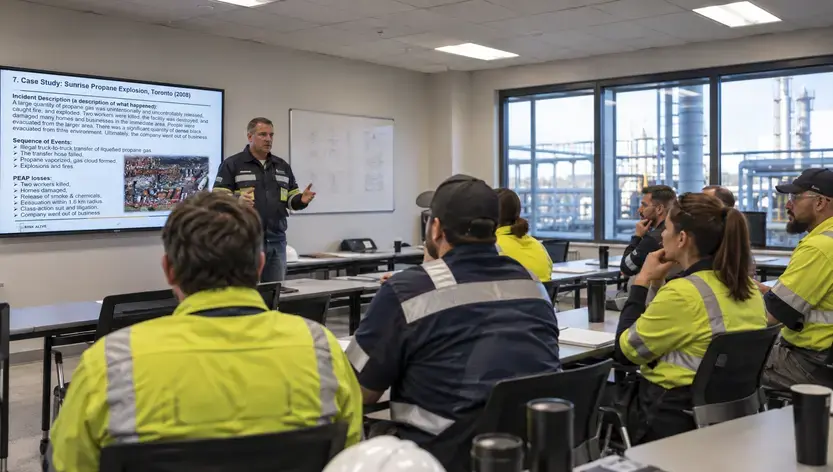
Your journey in risk management leadership. Definitions everyone agrees on. The key leadership responsibility for all leaders in safety. Understanding loss and the importance of risk management. Process safety incidents. The risk management cycle. Case study: the Sunrise Propane explosion. A practical AI exercise.
Module 2: Understanding How Incidents Develop
Hazard recognition and the Energy Wheel. Case study: the Fernie Memorial Arena loss incident. Assessing and controlling risks. Lagging and leading safety indicators. The incident model and the Discovery Approach. The incident investigation work process, categories of causes, an introduction to root cause analysis, and a different perspective on the Swiss Cheese model. A practical AI exercise.
Module 3: Building an Effective Risk Management System
Models for an integrated risk management system, and the case studies revisited through that lens. Risk management tools and how they support the system. Process safety and catastrophic incident prevention, including normalization of deviance, critical leading indicators, and “Mine the Diamond”: putting finite resources on the critical few risks with the most severe potential consequences. Management of change. Program evaluation and continuous improvement. A practical AI exercise.
Module 4: Leading Improvement and Learning from Others
A strategy of five practical actions to improve safety performance. Leadership at all levels. Learn from others: the case of the compressor noise. A final practical AI exercise, which completes the Operational Risk Intelligence Brief that each participant builds across all four.
Thirty topics across the four modules, with an AI exercise at the end of each one, so participants practise the same method four times rather than sitting through a single technology segment at the end.
What You Take Home
Every participant can generate a combined multi-page Operational Risk Intelligence Brief written on an operation of their choosing and centered on any of the key concepts presented in the course. For example, a brief built around “Mine the Diamond” covers:
• High-consequence scenarios that industry PHAs suggest should be checked
• Leading indicators to watch for, as signs of degradation before a consequence appears
• Potential blind spots, meaning what may have been overlooked or normalized
• Leadership questions to ask and verify
• Critical safeguards whose health matters most
• One first action to take back to site
Bring anonymized or non-confidential information about a facility, a unit, a recent event or a recurring weak signal. The exercise is built on your own operation, so arriving with a prepared description of the technology will be extremely advantageous to your time in the course.
The Case Studies
Three real-world cases are used to teach the concepts and to show the AI tools in action.
Sunrise Propane Explosion, Toronto. At around 3:50 in the morning on August 10, 2008, a propane release ignited at an industrial gas facility next to a residential part of Toronto. Two workers were killed. Residents within 1.6 kilometres were evacuated in the dark. The company did not survive it. Participants work backwards from the incident outcome to the management system weaknesses that allowed it.
The compressor noise. A 10,000 HP reciprocating compressor in ethylene service, discharge pressure above 40,000 psig, and a knocking noise that matched the compressor’s rpm exactly. The question put to participants is the one that was put to the operating team at the time of the event: Do we keep the plant running (production pressures) or do we shut it down? The session then shows what the AI tools return when that same question is asked today.
Fernie Memorial Arena. On October 17, 2017, an ammonia and brine refrigeration failure at a municipal rec centre in Fernie, BC, released ammonia into an enclosed room. Three people died and 95 residents were evacuated from 55 nearby homes. Technical Safety BC’s investigation report made 18 recommendations to improve ice rink refrigeration safety. The case sharpens the distinction between an occupational loss incident and a process safety loss incident.
The Industry Data Behind the Tools
The AI is the interface. The industry PHA intelligence behind it is what participants learn to apply to their own facilities.
Risk Alive has structured causes, consequences, safeguards and risk rankings from real, anonymized industry PHA studies. The Risk Intelligence Companion and the PHA Scenario Pattern Search are how a participant asks that body of experience a question in plain language. In the course, participants bring a process safety event or a technology from their own facility and ask what industry PHAs have already identified. What causes and consequences show up against this hazard. Which safeguards are commonly credited, and which controls industry PHAs rely on most. What their own assessment might have missed.
The tools do not replace the experience your people already have. They let them test that experience against what has already been assessed and protected against across industry. For a leader who has just moved into an unfamiliar unit, that is the difference between an opinion and a position.
Every participant gets free access during the course and keeps it afterward.
Your Instructor
John R. Cocchio, BASc (Chem. Eng.), MBA
John spent 32 years (1980-2012) at Dow Chemical Canada as a process engineer, production supervisor, reliability and improvement leader, and EH&S delivery leader. The units were world-scale: chlor-alkali, EDC-VCM, polyethylene, chlorinated solvents, epoxy resins, light hydrocarbons and wells storage, across Sarnia, Fort Saskatchewan, and Prentiss.
He then taught Leadership in Risk Management to senior engineering students at the University of Alberta, the David and Joan Lynch School of Engineering Safety and Risk Management, alongside introductory process safety management, from 2012 to 2025. He has delivered seminars and workshops through APEGA and directly to client companies.
John was a professional engineer, a member in good standing at the time of his retirement, with Professional Engineers Ontario (1980-1998) and the Association of Professional Engineers and Geoscientists of Alberta (1998-2025).
Who Should Attend
Written for people who are in a position to apply AI to everyday industry risk challenges, and who influence operational risk decisions now or will in future.
• Operations: operators, operating and power engineers, process and plant engineers, production supervisors, operations managers, plant managers
• Maintenance: maintenance supervisors, maintenance engineers and maintenance managers
• Process safety specialists, process engineering, reliability specialists, EHS and risk professionals
• High-potential engineers and engineers in training (EITs)
• New-in-role supervisors and technical subject matter experts and leaders
Best fit: a cross-functional site team who can apply the exercises to a real operational-risk priority in your facility. The exercises benefit most from having operations and maintenance in the same session.
Prerequisites and Related Courses
No prerequisites.
Recommended preparation. Each participant will get the most from the course by selecting and describing, in anonymized, non-confidential terms, a process operation, facility, unit, recent event or recurring weak signal of specific interest to them. This description is used in the AI exercises, and the outcome is the Operational Risk Intelligence Brief.
This course pairs well with:
• Fundamentals of Risk-Based Process Safety Management
• Introduction to PHA / HAZOP
Delivery
Live online. The course runs remotely, as one eight-hour day. Everyone joins the same session at the same time, sees the instructor and the AI tools on screen, and asks questions as the day goes on. There is no classroom to travel to.
Private sessions. The same day can be run privately for a single organization, with content built around your own processes, units and operational data, so the exercises use material your team recognizes. Contact us for group pricing.
Why Choose Risk Alive
Risk Alive is a specialized process safety firm providing expert PHA facilitation services, industry-leading training, along with the Risk Alive Platform and Risk Intelligence Companion software solutions.
Senior practitioners with 30+ years of active field experience. Our instructors are practicing process safety professionals. The case studies, the design errors caught late, the conflicts over keeping a unit running, all of it comes from situations they have actually been in.
Live online delivery. Join from anywhere. Public sessions run live online, and the same day can be run privately for your organization.
Tailored to your processes, units, and data. For private sessions, Risk Alive can customize training content to your company’s specific processes, units, and operational data.
End-to-end partnership. From senior-led PHA/HAZOP facilitation services, to training your internal team, to equipping them with the analytics and AI software, Risk Alive supports the full process safety competency journey.
Professional development credits. Participants earn CEUs or PDHs toward ongoing certification.
Government grant eligibility. Many participants and companies qualify for government training grants that can help offset course costs. Contact us to learn which programs may apply to you.
Complimentary industry-wide risk intelligence access. Every course student is given access to the Risk Alive AI tools, which search anonymized industry PHA data: causes, consequences, safeguards, and risk rankings from real studies.
Frequently Asked Questions
Where does the course take place?
Online. The course is delivered live and remotely, in one eight-hour day, and there is no in-person option for public sessions. You join from wherever you are.
Do I need to prepare anything?
Yes. Bring anonymized or non-confidential information about a facility, unit, recent event or recurring weak signal you are responsible for. The exercises run on your own operation, after the instructor demonstrates the method on a case study.
Do I need a technical background?
No. The technical primers are built into the case studies.
Do I need to know anything about AI?
No. The course teaches how to use these two tools from the beginning, including how to judge the answers they give.
Is a recording available if I cannot attend?
No. The day is taught live, and the exercises run on each participant's own operation, so attending the session is the course.
Do I keep access to the AI tools?
Yes. Graduates keep free access after the course ends.
Can we run this for our own team?
Yes. The same day can be run privately for your organization, live online, with the content built around your own units and data. Email info@riskalive.com.
Are grants available?
Many Canadian employers qualify for training grants that offset part of the cost. Contact us and we will tell you which programs may apply.
Cancellation
Need to Cancel? Here’s How